



Rico puts the Aera M-1 Field through real-world wear to see whether this modern Dirty Dozen descendant rates the heritage behind it.
By Rico (@ricoswatches)
Disclosure: Aera provided the M-1 Field to me for the purpose of this review. It was not purchased by me. The opinions below are my own and are based on my extensive real world testing and use of the watch.

Why the Dirty Dozen Keeps Getting Reinterpreted
There are two kinds of military watch people. One group wants the real thing: a 1945 W.W.W. with a Broad Arrow on the caseback, a story, and a price that reflects eighty years of scarcity. The other group wants the idea of the thing, built to survive a modern life. I'm a tool-watch guy at heart, and as a police officer I want a watch that reads instantly and doesn't need babying, so a field watch built on the Dirty Dozen template gets my attention fast.
The Aera M-1 Field is one of the more interesting attempts at it. It isn't a homage in the typical sense. It takes the recipe the British Ministry of Defense wrote in the 1940s, keeps the parts that make a field watch a field watch, and then sculpts the case into something that looks like it came from a different decade entirely. Whether that's a good thing depends on what you want from a field watch, and that's what the rest of this article is about.
To get there, we need three things: who Aera is, what the Dirty Dozen actually were, and how the M-1 Field measures up on the wrist.

Aera: The Brand
Aera is a British-designed, Swiss-made brand with a founding story that has a few layers, so I'll take them in order.
The origin. Aera's own About page says it began in Geneva in early January 2018, when a small group of watch lovers from different corners of the industry sat down to ask one question: what defines a good watch? The name was chosen to mean a period of time with a distinct character, something memorable and long lasting. The first watches reached the public in July 2022, which is why you'll see the brand's founding dated to both 2018 and 2022. Both are right depending on whether you count the idea or the first watch.
The founders. Jas Minhas and Olof Larsson are the two names on it. Minhas is British, and Aera is his fifth start-up venture. His watch roots go back to his father, Surjit, who came to Birmingham from India in the early 1960s, worked a stint in the RAF and at Triumph, joined the jeweler H. Samuel, and eventually opened his own watch shop, which was called Aero Watches & Jewellers. In the 1980s Surjit moved into distribution, bringing brands like Movado, Favre Leuba, Marvin, Luxor to the UK, distributing Seiko 5 and Citizen automatics and he was the exclusive UK importer of Renata batteries for more than twenty-five years.
Minhas’ grandfather was a watchmaker in Punjab, and his father repaired watches at the kitchen table whilst he was growing up. Minhas himself went on to help launch Jawbone in Silicon Valley with the designer Yves Behar. Larsson comes from the other side of the industry. He’s the heir to Nymans Ur, a Swedish watch retailer owned by his father Goran.
The two met in the late 1990s at a party in Sweden hosted by Marc Newson, the Ikepod founder, for whom Minhas was consulting at the time and Larsson was a retailer of the watches. They hit it off over design and a shared plan to build a watch brand one day. Two decades later, in 2017, Minhas met with Larsson in Stockholm with a message along the lines of: I need a change, what about that watch company we always said we would build? The decision, by his account, took a split second.
The philosophy. Aera targets a sweet spot of roughly £1,000 to 3,000, a segment Minhas says Swiss watchmaking has largely abandoned. The approach is a kind of reverse engineering: use decades of trade knowledge to source the best parts at a rational price, with the explicit goal that the watches should be repairable in fifty or a hundred years. That explains the recurring ingredients across the range: 904L steel cases, Sellita workhorse movements, and Swiss Super-LumiNova. The brand sells direct and online in editions of 300 pieces, with a small number of retail partners such as Krons Ur in Stockholm.
The lineup. The first two watches were the D-1 Diver and the P-1 Pilot, both with rounded, softened case designs. Since then the family has grown into divers in several colourways, pilots, the C-1 chronograph line, and the M-1 field watches: the Field, the Blackbird, the Dune and the Krons. Aera has also done collaborations with Todd Snyder, Firmship, Woolrich and Rennsport.
The packaging, because it's part of the character. Every M-1 Field comes in a handmade black pebble-grain Italian leather pouch, and Aera says its wider packaging is 100% recyclable and biodegradable, with digital rather than printed manuals. It's a small thing, but it tells you the brand thinks about the unboxing as an extension of the design language rather than a cardboard afterthought.
As of November 2026, every Aera watch comes with a five-year manufacturer's warranty. This also applies retroactively to watches already owned prior to this updated policy, not just new purchases.

The Dirty Dozen: Where the M-1 Gets Its DNA
The wristwatch earned its place in military kit in the First World War. Pocket watches were awkward in the trenches, and fumbling with one while behind cover could expose a soldier's position, so men strapped them to their wrists. That evolved into the trench watch: a small pocket-watch case with wire lugs soldered on, bought privately rather than issued. Over the course of that war the design got field-tested the hard way. Dials flipped from black-on-white to white-on-black for legibility, and luminous paint, which in that era contained radium, arrived so a watch could be read in the dark.

By the early Second World War there was still very little standardization. Before the Dirty Dozen, the British military's wartime watch was the A.T.P., short for Army Trade Pattern, ordered in 1939 from a group of Swiss makers. Its spec was simple: black dial, Arabic numerals, night legibility, a shatterproof crystal and a railroad minute track. Those watches were good, but they were still a trade product adapted for service.
The next step was a proper general-use military wristwatch. In 1943 Commander Alan Brooks, later a Field Marshal, recognized that the armed services needed one, and the Ministry of Defense's commission followed in 1945. The requirements were demanding for the period: a black dial with Arabic numerals, a subsidiary seconds at six o'clock and a railroad minute track; luminous hour and minute hands plus hour markers; a movement of 15 jewels between roughly 11.75 and 13 ligne; a shatterproof Perspex crystal; waterproofing to the standards of the day; chronometer-grade regulation across a range of conditions; a rugged shock-absorbing case; and a crown of good size that could be operated and sealed.

The military designation was W.W.W., for Watch, Wristlet, Waterproof. Each watch was engraved with the Broad Arrow, the mark of Crown property, and carried two serial numbers on the caseback, the maker's civil number and a military number beginning with a capital letter. They were issued as General Service watches, which didn't mean every soldier got one. They went to specialists who needed to know the time precisely: artillery, staff officers, engineers and signals personnel.
Britain's own watch factories were busy making munitions, so requisition officers went to Switzerland, which as a neutral country could keep trading. Twelve companies were chosen: Buren, Cyma, Eterna, Grana, Jaeger-LeCoultre, Lemania, Longines, IWC, Omega, Record, Timor and Vertex. Roughly 145,000 watches were delivered in total. Vertex is the odd one out. It was technically a British company, though it relied on Swiss manufacturing partners, and it supplied 15,000 of its Cal 59 pieces. Vertex later relaunched in 2016 with the M100, which Don Cochrane based on that watch and the MoD brief.

The sizes were small by modern standards, with the IWC Cal 83 example at about 35mm and the Longines 12.68Z example at about 38mm, which is among the largest of the set. The IWC watch also pointed the way to the Mark XI pilot's watch. Production volumes varied widely, with the likes of Grana and Eterna making relatively few, which is part of why completing a full set is such a chase. The chase is complicated by the fact that the Royal Electrical and Mechanical Engineers (REME) serviced these watches without much sentimentality and often swapped parts between makers, so a "correct" example is harder to find than the numbers suggest.
As for the name, collectors started calling the group the Dirty Dozen after the 1967 war film, and it stuck. The real thing is a serious money proposition: a Longines example has been listed at roughly HK$59,980, about 7,400 euros. That's the gap modern interpretations like the Aera M-1 are trying to fill.

From the Dirty Dozen to the M-1
Aera describes the M-1 as inspired by the Dirty Dozen, and the DNA is clear when you line the specs up with the MoD brief. The black dial, the Arabic numerals, the railroad minute track, the recessed subsidiary seconds at six and the luminous hands all come straight from the 1945 recipe. A hand-wound movement is also the right call for a watch with this lineage.
What's changed is just as telling. The original watches were around 35 to 38mm and used shatterproof Perspex crystals, with waterproofing to the standards of the day. The M-1 Field is 39mm across, 13.14mm thick and 47.6mm lug to lug, with a domed sapphire crystal, 100 metres of water resistance and a flowing 904L case that has very little in common with a 1940s military case. Aera kept the dial brief and rewrote the case brief.
The dial carries Aera's signature dished, one-piece construction, which together with the domed crystal creates the three-dimensional look Aera is chasing. The numerals and the Aera logo are cut from solid blocks of a lume material called Globolight and applied by hand, and the hands, markers, crown pip and sub-dial track are filled with Super-LumiNova Grade X1.
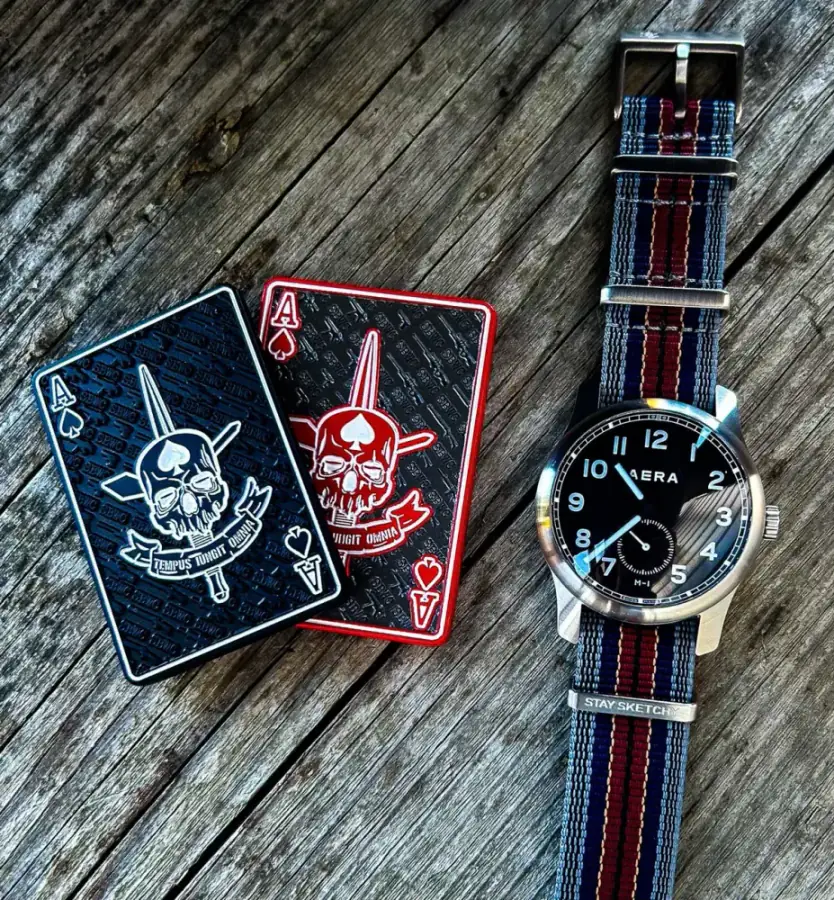
The Aera M-1 Field

The Numbers
The case is 904L stainless steel with a satin-brushed finish, 39mm in diameter, 13.14mm thick, 47.6mm lug to lug, with a 20mm lug width. It weighs 65.2 grams without the strap. Water resistance is rated at 10 ATM, or 100 meters, and the caseback is a two-piece screw-in design. The crystal is domed sapphire. The movement is a Sellita SW216-1, hand-wound, beating at 28,800 vibrations per hour with a 42-hour power reserve, hacking seconds and 24 jewels. It's finished in the Elabore grade, and Aera states a tolerance of plus or minus 7 to 15 seconds per day.

The Case and Wrist Presence
This is where the M-1 stands apart from every traditional field watch. The case is brushed on every surface and almost entirely free of hard edges, with one continuous curve running from the domed crystal across the bezel and down the sloping lugs into the strap. It doesn't look like a Dirty Dozen. It looks like Aera.
I found the watch extremely light and comfortable on my wrist. The curved UFO like case never caught on shirt cuffs and the thickness sits at that sub 14mm sweet spot that avoids door frames and steering wheels. I did take the M-1 off the supplied fitted straps provided by Aera and put it on one of our inhouse SBWC J11B "The Hill" straps. I personally really enjoy this combination and makes the watch feel much more like a hard use instrument, more in the vein of the original Dirty Dozen watches. I wore this watch daily at work and put it through its paces in all sorts of call types and dynamic situations and it performed flawlessly. There was a certain nostalgic charm in wearing a watch that draws its inspiration from a watch worn by commonwealth warriors of days gone but with a modernized design built for the present day.
I'm a domed-crystal, no-date, tool-first person, and the M-1 ticks the first two boxes outright. On the third point, the case material is a point in its favour on corrosion. 904L has a higher chromium and nickel content than the 316L most brands use, and since every surface of the Field is brushed, everyday scratches should blend in rather than shout. I appreciate the use of 904L as it further demonstrates an ethos of striving for excellence that is prevalent at Aera. They didn't need to do it, but they did and it's a nice touch.

Dial, Lume, and Legibility
The dial is a matte black with white numerals and a railroad track around the edge. Aera says the hands, markers and crown pip carry hand-applied Super-LumiNova, which means each watch is slightly different, and the Globolight numerals glow a military green while the logo glows white. A sub-dial track and hands filled with X1 grade lume, plus solid-cut numerals, is an unusually thorough approach at this price.
In my usage both in normal daily life and at work, I can say that I found the Globalight lume to be highly legible and clean to read under all conditions and to last well through the night. The application of lume to the top of the crown was also a nice touch both in form and function. While Globalight is starting to become more and more prevalent in the watch space thanks to brands like Christopher Ward and Tudor (brands that we here at the SBWC are no stranger to) it is still regarded as a premium offering and its stark contrast against lesser lumes is staggering. Long story short: the lume is great and due to the simplicity of the design, it is one of the defining features of the M-1.
The design philosophy is legibility through scale: large numerals, large hands and a sub-seconds register that doesn't crowd the dial. At 39mm it's Aera's smallest watch to date, and the larger hand-applied numerals are meant to compensate for the size. It's a smart trade, and it's very much in the spirit of the 1945 spec.

The Movement
The Sellita SW216-1 is a workhorse, and Aera has been open that this is a deliberate choice: easy to service, widely supported, and likely to be repairable decades out. It's also Aera's first hand-wound movement. A field watch you wind is a field watch with a ritual, and it also drops the rotor and the thickness that comes with it.
I genuinely enjoyed winding the watch every day before strapping it on my wrist. It calls back to that nostalgic sentiment that one experiences with this watch and puts it in line philosophically with the original W.W.W.'s and their intended user interface. It also harkens to the duality of this piece. A watch that does such a fantastic job of straddling the line of historical inspiration and contemporary design.

Straps
The watch ships on a smooth coffee brown Italian leather strap with white stitching and a 904L buckle, plus a complimentary charcoal grey suede strap. Both are integrated, fitted-end designs with quick-release spring bars for easy swapping, which Aera says took three years to perfect so the case and strap form comfortably around the wrist. This is another point where the M-1 behaves differently to a traditional field watch.
While this is a highly capable watch, it feels like it is designed to be a premium item. The straps that the M-1 are offered with are great if you want to dress it up or work in a more docile setting, but if you are doing field work like many of you readers are, I would highly recommend swapping to a fabric strap of your choice. Be it one of ours at the SBWC or otherwise. That really changes the wear experience of the watch and solidifies it as a capable tool. Ultimately, this watch can do it all, it just needs to swap shoes every once in a while.

How It Stacks Up
The obvious competitor is the Hamilton Khaki Field Mechanical, which costs considerably less. The M-1 isn't trying to be the cheaper Hamilton. It's a pricier, more stylized, more finished interpretation. If you want the traditional silhouette, Hamilton or a Dirty Dozen-style piece like the Vertex M100 are closer. If you want the dial recipe in a different case, this is the one.
Against my own collection, which leans diver-heavy with the Tudor Pelagos, Rolex Sea-Dweller, Marathon Osar, an Ares Diver-1 GMT and a DOXA 300T Professional, the M-1 occupies a completely different slot. It's the only hand-wound field watch in that conversation, and nothing in my box covers that gap. That's the honest case for it: not that it beats any of those watches at what they do, but that it does something they can't, and it does it with a domed crystal and no date. The way I like it.

The Verdict
The Aera M-1 Field is a smart answer to a question the Dirty Dozen has been asking collectors for eighty years: how do you keep the dial and ditch the fragility? Aera keeps the spec that made those watches readable and reliable, then wraps it in a modern case built from materials chosen for longevity and designed to the appetites of a contemporary consumer. The movement is easy to service and a joy to wind, the lume is thoughtfully executed, and the packaging tells you the people behind it care about the details.
If you want a field watch that looks like nothing else in the category and is built to be a worthy companion for decades to come, this is worth a serious look. As someone who has always had a preference for dive watches but felt there was a field watch shaped hole in my collections, the Aera M-1 Field may in fact be the one to finally fill it.
Stay Sketchy.


