


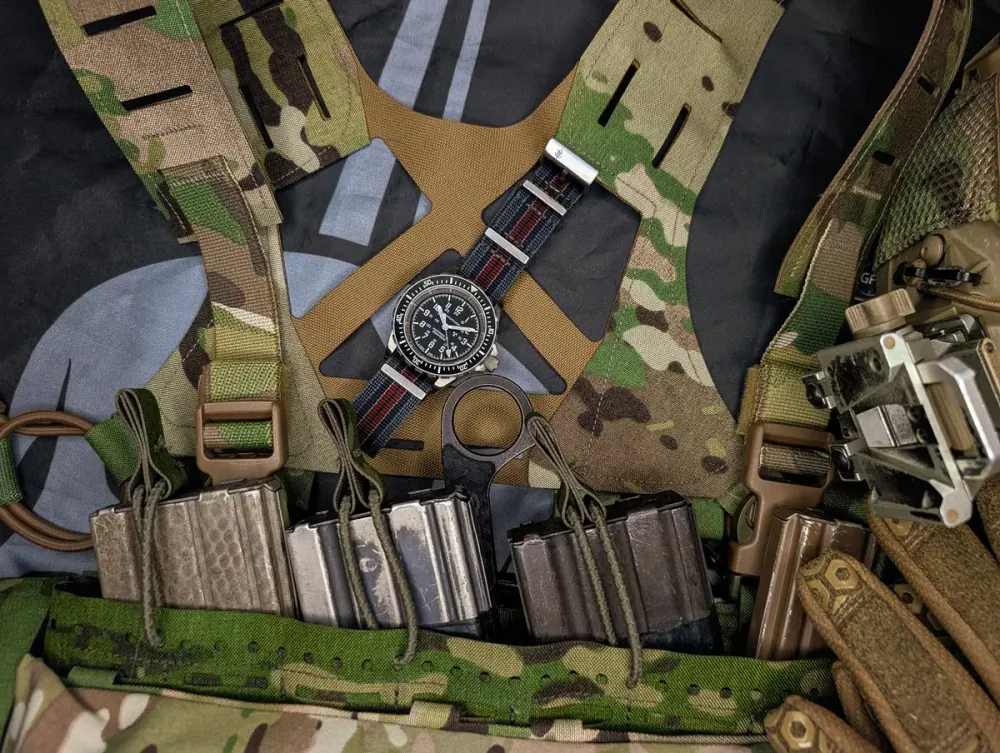
The Marathon GSAR Ti brings proven military-grade durability to the wrist with a Grade 5 titanium case that’s roughly 30% lighter than its steel counterpart, 300m water resistance, tritium illumination, and an upgraded 6...
SBWC Field Report by @ricoswatches

Author's Note: Full disclosure up front, because that's how we do things here. SBWC is an authorized Marathon dealer, and this article exists to tell you about the GSAR Ti pre-order we're running. I wouldn't put my name on it if I didn't think the watch earned its metal, but you should know where I'm standing. Two more things. I haven't had the GSAR Ti on my wrist yet (Marathon has advised a 17 November fulfilment date), so everything about the watch below comes from Marathon's specs and our product listing, not hands-on time. And the military and medical material is research, not personal experience. Hands-on impressions will follow once one lands.
Anyone who has worn a duty belt knows that ounces turn into pounds by the end of a shift. Weight is the quiet enemy of every piece of kit, and nobody is more obsessed with beating it than the people who build military hardware. So when Marathon announced that the GSAR was finally going titanium, I wanted to know why this one metal keeps turning up everywhere the stakes are highest. The answer is a lot cooler than "it's light."
In the Air

Start with the fighters. Titanium makes up roughly 42% of the F-22 Raptor, about a third of the F-35 by some counts, and around 13% of the F/A-18 Super Hornet. It lives in airframes, landing gear, firewalls that have to shrug off temperatures north of 600°C, and the compressor blades and discs spinning inside the engines.
Here's the part that got me. The main titanium alloy on the Raptor is Ti-6Al-4V, which is the exact alloy we call Grade 5. Same stuff Marathon is cutting this case from.
Behind the Armor

On the ground, titanium plate replaces heavier steel on combat vehicles, personnel carriers and tanks like the M1 Abrams, and on hatches like the ones on the M2 Bradley, where every pound saved is range, speed and payload. The A-10 Thunderbolt II takes it furthest. The pilot sits in a titanium "bathtub" built to stop 23mm autocannon fire. That's a metal trusted to keep a human being alive while everything around him is being shot at.
Under the Sea

Salt water eats metal. Titanium doesn't care. Pure titanium and specialized alloys like TIMET 5-111 go into submarine hulls, seawater cooling systems, propeller shafts, exhaust stack liners and ball valves. Beyond killing corrosion, it helps lower acoustic signatures, which matters when your whole job is not being heard. A Search and Rescue diver's watch lives in that same salt, and that's the reason a titanium GSAR makes sense to me.
Heavy Guns, Lighter Loads

Towed artillery like the M777 howitzer and various mortar systems use titanium alloys to cut total system weight by up to 50%. That's the difference between a gun you can sling under a helicopter and one that stays put. Titanium also goes into rocket cases, missile structural skins and control systems that have to live through brutal heat and aerodynamic pressure.
The Four-Legged Operators

This is my favourite one. Police and military working dogs, mostly German Shepherds and Belgian Malinois, get custom-milled titanium crowns over fractured or worn canines. It's done strictly out of medical necessity: a vet performs a root canal and cements the crown on, and the dog keeps a strong grip for apprehension and service work instead of losing the tooth. Cost runs from $600 to $5,000 per tooth, and crowns can occasionally dislodge under extreme working pressure and need re-cementing.
Titanium keeps these dogs moving in other ways too. 3D-printed implants like the TTA RAPID system treat cruciate ligament failures and knee instability, and custom titanium prosthetics, like front-paw replacements, have been fitted on injured working and rescue dogs. For a guy who works patrol, a working dog's mouth is about the most honest durability test I can think of.
For the Ones Who Served

Titanium is the preferred metal in medicine because it's biocompatible and doesn't break down in bodily fluids. A protective titanium oxide layer forms when it meets air, and bone-forming cells can fuse directly to it (osseointegration) with no artificial adhesive needed. The VA uses it for joint replacements like hips and knees, bone plates, pins and spinal stabilization hardware. Veterans who qualify for comprehensive VA dental benefits, such as those rated 100% service-connected disabled and former POWs, can receive titanium dental implants when medically necessary. Light, strong titanium alloys also go into high-tech prosthetic limbs and ultralight wheelchairs.
The Part That Isn't a Highlight Reel

Titanium's story with veterans isn't all positive, and I'd rather say so. Researchers studying soldiers who came home from Iraq and Afghanistan with unexplained shortness of breath have found microscopic titanium, fused with iron and in some cases copper, in biopsied lung tissue, alongside constrictive bronchiolitis, a rare and irreversible inflammatory lung disease. The airborne hazards of the burn pits are the exposure that research points to, and exactly how those particles relate to the illness is still being worked out. That's metal dust in the air. It has nothing to do with a solid case on your wrist, but anyone who went through it deserves the context.
Which Brings Us to the GSAR Ti

In my steel GSAR review I called it a home run of a watch, and I still do. The formula works: government lineage, tritium, a 300m rating and a case built for gloves and salt water. Marathon's answer here isn't to reinvent it. It's to change the parts that matter:
-
Case and hardware: Grade 5 titanium for the case and the hardware on the 3-piece FKM rubber strap kit, roughly 30% lighter than the 41mm steel GSAR.
-
Movement: Sellita SW200-2 Top Grade with Incabloc shock protection, a higher accuracy rating and a 65-hour power reserve. The steel GSAR I reviewed runs about 38 hours, so that's a big jump for a watch you take on and off the wrist.
-
Dial: updated numerals, a black date window, and the "Ti" in AUTOMATiC printed in red for titanium's chemical symbol.
-
Lume: tritium gas tubes on the hour markers and full hand set, with MaraGlo on the bezel pip.
-
Everything else: 120-click uni-directional 60-minute bezel, sapphire crystal, 300m water resistance, 41mm diameter, 13.5mm thick, 20mm lug width and 48mm lug-to-lug.
Grade 5 is the tougher, more scratch-resistant alloy compared with the commercially pure Grade 2 some brands use, and it's the same alloy flying in the world's most advanced fighters. Marathon's first titanium case showed up last month in a limited 200-piece collab with Watches of Espionage, and the GSAR Ti is the first standard-production Marathon in the metal. Missed that drop? This is your way in.
Why You Want This One

The military didn't pick titanium for being flashy. It picked it because it's light, strong and doesn't quit in salt water or heat. Now put that on your wrist: a case roughly 30% lighter than the steel GSAR, a 65-hour movement that will outlast a long weekend on the dresser, and tritium that glows every minute of every night with no charging. It's the GSAR you already trust, built from the metal that flies in the world's most advanced jets.
The Marathon GSAR Ti is up for pre-order now in the SBWC Armory at $2,750 USD, with Marathon advising a 17 November fulfilment date. We're an authorized Marathon dealer, so it's covered by Marathon's 2-year warranty (extendable to 3 years with registration), and we ship to APO, FPO and DPO addresses too. Get your pre-order in now and be first in line when they ship.
Order the Strap Assembly, SBWC, J11B, ("The Hill")
Stay Sketchy.
-Rico


