



A 500-meter mechanical chrono from a watchmaker with crazy history that I'd never heard of? That's enough to get my attention. The Ollech & Wajs Astrochron is here to stay.
I had never heard of Ollech & Wajs.
Not a particularly flattering admission from someone who spends an unreasonable amount of time looking at watches, talking about watches, writing about watches, and occasionally convincing himself that another watch is somehow a necessary acquisition… and bounces all of this off of his wife's glazed over eyes… But there it is.
Rico was responsible for putting the brand on my radar. A little cursory research suggested that Ollech & Wajs was one of the few remaining companies still doing things “the old way”. That was interesting enough to warrant a closer look.
Then I found the Astrochron.
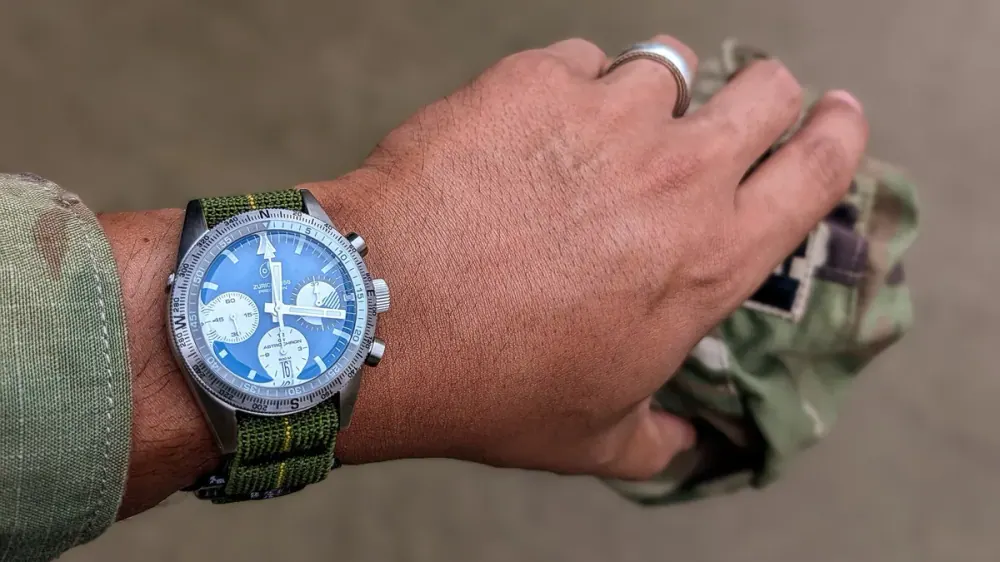
A mechanical chronograph with a compass scale. And a dive-timing bezel. And a killer blue dial. With five hundred meters of water resistance.
Five. Hundred. Meters.
In a chronograph.
I wasn't looking for a chrono—the thought had never crossed my mind, but the Astrochron was an immediately intriguing proposition, and the more I looked at it, the more I wanted to know what the hell Ollech & Wajs ("OW" will be used here and there) was doing.

As it turned out, the watch was sold out. OW had to build an example for this review, which gave me plenty of time to go digging through the company's history.
That rabbit hole eventually led me to NASA, Vietnam, and a watch company with a far more interesting past than I had anticipated. But that's getting ahead of ourselves.
Chicken or egg, I'm not certain what you think. In this case?
The watch came first.
Disclosure: Ollech & Wajs supplied the Astrochron on its Regatta Perlon strap for this field report. The retail price of this configuration at time of this publication is $3,401 USD. No conditions were imposed on the review, OW had no editorial approval, and nothing was submitted to the company for review before publication.
Five hundred meters. In a chronograph.
The modern Astrochron was introduced in 2023 as a revival of the original model launched in 1967. On paper, it's quite an unusual collection of specifications. The case clocks in at 39.5mm and approximately 17mm thick. “CHONK” comes to mind. Inside is an automatic Valjoux 7753 chronograph movement. The watch incorporates a dive-timing scale and compass indications, with water resistance rated to 500 meters.
There's that number again: FIVE. HUNDRED. METERS.
And unlike a lot of watches that borrow the visual language of professional instruments, the Astrochron doesn't appear particularly interested in simplifying itself for the sake of broad commercial appeal. It is a relatively compact, rather thick, mechanically complicated watch with an unapologetically busy bezel. (Come to think of it, it really sounds like me—5’9”, 225lbs, and complicated.)

That combination isn't going to appeal to everyone (neither do I)... And frankly, that's good. Not every watch (or person) needs to.
The 500-meter rating was what initially got my attention. It's a remarkable specification for a mechanical chronograph, particularly one with a case diameter under 40mm. But a specification is only interesting for so long. Eventually, the watch has to come out of the box and go on your wrist—that's where the Astrochron started making a much stronger case for itself.
Smaller than expected. Heavier than expected. Better than expected.
My initial impression was that the Astrochron was heavy, but balanced. I expected it to wear larger than it did; between the stated thickness, the chronograph architecture, and the product photography, I'd prepared myself for a fairly substantial chunk of steel. Instead, I found a watch that wore noticeably smaller than anticipated.
That's not to suggest that the Astrochron is thin. It absolutely isn't. At nearly 17mm (16.8mm to be exact), there's no point pretending otherwise. Understanding that thickness doesn't bother me, it was still a bit of a surprise seeing it in the metal. Despite that, the case is well balanced, and the curvature of the lugs does a great deal of work in keeping the watch comfortable and reasonably close to the wrist. I've said this before, and the Astrochron only reinforced it: case thickness tells you considerably less about how a watch wears than the geometry of the case itself.

The other immediate surprise was the dial; between the three chronograph registers, date display, and the various indications surrounding it, there's a fair amount happening here, yet the dial remains remarkably legible. OW has resisted the temptation to apply oversized metal surrounds to every hour marker. The applied numerals at 3, 6, 9, and 12 provide enough visual structure without overwhelming the remaining indices. More applied furniture would have made this thing a mess.
The blue is another pleasant surprise. Product photos only tell part of the story, and that part was, “Damn, I like this color”. In my hands, it's a striking color, particularly when paired with the supplied blue Regatta Perlon. On paper, that sounds like a lot of blue, but on the wrist, it works. I would discover over the following months, the Astrochron is considerably more accommodating of questionable strap decisions than it has any right to be. More on that later.
Two sets of lug holes. One very useful detail.
Initially, I wasn't thrilled with how tightly the supplied Perlon sat against the case, and when I went to remove it, I noticed something. The Astrochron has two sets of spring-bar positions in its lugs, including an externally drilled set. The different positions accommodate bracelet and strap fitment, but they also provide a useful means of fine-tuning how a strap sits against the case and, depending on the strap, how the watch fits on the wrist. It's a small detail, but one that became genuinely useful during my time with the watch.

I've spent enough time swapping straps to appreciate a manufacturer that makes the process easier rather than treating the spring bars as some sort of proprietary secret. The crown deserves a mention, too: unscrewing it, winding the movement, and setting the watch all feel satisfying. The date corrector at 10 o'clock requires deliberate operation, and I've never accidentally activated it. Simple. It just works. Tried and true, they're just well-executed controls that feel like they belong on an expensive mechanical watch. Exactly as it should be.
Apparently, I needed a chronograph.
Before owning the Astrochron, I never particularly found myself wishing I had a chronograph. It felt so unnecessary. I've owned and worn plenty of divers, and a rotating bezel has always been more than sufficient for most of the things I've needed to time... Until I started wearing this thing.
I've had the Astrochron since June. Initially, it was on my wrist roughly three times a week. For a couple of weeks, it was the only watch I wore in the field. Since then, it has remained in consistent rotation. I can't truthfully tell you if it was a fidget of sorts or just being enamored with something new-to-me, but however it started, I've ended up using the chronograph constantly.

PT tests. Personal runs. Cooking. Timing various activities with the kids.
Yes, even time-outs. Part of me wonders if they factor in strong-willed children getting in trouble when it comes to testing watch complications. (I don't think they do…) I've also used it as a backup when I've forgotten to charge my Garmin, which happens with an embarrassing degree of regularity. At the time I was putting together my notes for this article, I was using the chronograph to time that process, too—about 45 minutes and change.
The irony is that I now use the chronograph more frequently than I use the dive bezels on most of my other watches. I genuinely didn't see that coming.
Of course, none of these activities requires a mechanical chronograph. A phone, digital watch, or cheap stopwatch would accomplish the same thing, but that's not really the point. The Astrochron makes the function immediately accessible, and the experience of operating it is satisfying enough that I actually want to use it. The pushers are excellent. I've handled chronographs with soft, somewhat ambiguous pusher action. The Astrochron is the opposite. Starting, stopping, and resetting the chronograph are deliberate actions accompanied by a firm, authoritative click. There's no wondering whether you've successfully engaged the mechanism.
The registers themselves are clean and easy to interpret. There was a brief period during unboxing when I found myself staring at the dial and trying to figure everything out, largely because I was looking at the information without actually taking the time to understand it (an infantryman trying to wing it? Absolutely shocking, right?).
Once familiar with the layout, operation became intuitive. Now it wasn't like the discovery of the Monolith—the chronograph didn't transform my life. It did, however, change how I think about complications.
Turns out, sometimes you don't know you want something until you actually start using it.
Nearly 17mm thick. So what?
Let's address the obvious objection. She t h i c k. Someone comparing specifications might reasonably look at a 39.5mm watch approaching 17mm in height and immediately dismiss it. I understand the feeling, but I just don't share it.
For context, I own several Marathon SAR variants, including the GSAR, OSAR, TSAR, and MSAR (all of them, I own all of them). I also own a Marathon JDD, which is an entirely different exercise in how much watch a person can strap to their wrist. For the uninformed, the SAR family consists of substantial military-oriented divers. They're thick, chunky watches, and their bezel designs contribute to a relatively snag-prone profile when worn around equipment.

Despite the Astrochron's stated thickness, I find that it wears considerably more discreetly. The difference comes down to case geometry and how the watches occupy space on the wrist. The JDD makes the contrast even more apparent. That watch occupies substantially more real estate, and its weight is something I actually notice. While compiling my notes into the draft for this article, I found myself checking beneath my hoodie cuff to confirm that I was still wearing the Astrochron.
I was.
A watch approaching 17mm thick had effectively disappeared beneath my sleeve. That's a much more useful observation than simply looking at two thickness measurements and declaring one watch more wearable than the other.

During my time in the field, the Astrochron has accumulated some marks around the lugs. I can't say with certainty whether they came from contact with a weapon, magazines in my chest rack, or another metal surface. Otherwise, the watch has held up well. It hasn't presented any significant problems with my clothing or equipment, although I would expect some of OW's thinner models, such as the Early Bird or 8001, to be less prone to catching on things.
The Astrochron is not a small, delicate dress watch masquerading as a professional instrument. But neither is it the unwieldy slab its dimensions might suggest. If you're comfortable wearing a Marathon SAR, I suspect you'll find the Astrochron entirely manageable… And if you've spent any meaningful amount of time wearing a JDD (effectively the best execution of a set of knucks disguised as a watch that I've ever come across), the Astrochron might feel downright civilized.

What works. What I'd change.
There's a lot I like about the Astrochron's execution.
The blue dial, restrained use of applied indices, legible registers, crown operation, and chronograph pushers all contribute to a watch that feels cohesive despite its relatively complicated appearance. I also appreciate that OW has remained faithful to the original Astrochron's design.

When a company revives a historical model and retains the original name, I want to see a genuine relationship between the two, not simply a vaguely vintage dial attached to an otherwise unrelated watch (aka the nostalgic cash grab). The modern Astrochron feels like a continuation of the original design rather than a cynical exercise in nostalgia—that doesn't mean I wouldn't change a few things...
The crystal. The domed crystal introduces some distortion at certain viewing angles. It doesn't make the watch unusable, and I generally find the dial surprisingly legible given everything happening beneath the crystal. Nevertheless, I would personally prefer a flatter profile. The distortion is something I continue to notice, and it's probably my most consistent criticism of the watch.
The lume is bright, but compared to watches with larger plots it won't be winning any competitions. If I've spend enough time outside, I can usually tell the time once my eyes adjust when I wake up around 0430. The Astrochron's relatively compact dial and restrained marker dimensions impose some obvious limitations on the amount of luminous material available. My instinct is that substantially larger plots would require compromises elsewhere in the design, namely a larger dial and case.

That isn't a measured engineering conclusion, and there are certainly other factors involved in luminous performance. It's simply how I understand the trade-off presented by this particular design. The comparison with my Marathon watches is instructive: Marathon's tritium-equipped models offer a different approach to nighttime visibility, while the OSAR's larger luminous plots provide an advantage in my experience. The Astrochron doesn't match them in that respect.
I don't consider it a dealbreaker, but it's worth acknowledging.
The Astrochron's bezel combines dive-timing and compass indications, and the visual division between those scales makes me wish they could rotate independently. They don't. Would I actually use an independently rotating compass scale? Probably not. In fact, I'd argue that a standalone compass bezel is among the least useful bezel configurations for my own purposes (counterintuitive to some, perhaps), but the design makes me want the functionality nonetheless. More practically, I'd love to see OW offer an alternative bezel configuration with a conventional elapsed-time scale or, better yet, a countdown bezel.
That would be a genuinely appealing option for how I use watches. To be clear, the existing bezel isn't defective. This is a preference about the functionality and configuration I'd personally choose.
Apparently, this company has been doing this for a while.
I didn't approach this watch because I was already enamored with Ollech & Wajs. I approached it because I found the modern watch fascinating. The history came afterward… and there is a hell of a lot of it.
The original Astrochron debuted in 1967, during an era when aviation, diving, and aerospace engineering were advancing at an extraordinary pace. OW's own historical account connects its chronographs to scientists working within NASA. According to the company, NASA scientists who were impressed with their own Astro-Chrons presented one to Wernher von Braun. That's an interesting distinction. OW itself describes the association as a dubious honor.

The account does not establish that an Astrochron traveled to space (NASA had some silly requirements and OW was not old enough as a brand to compete for the honors), nor should it be confused with the documented history of watches worn on lunar missions. What it does illustrate is the company's connection to professionals working in aerospace during the space race. The broader point is that the Astrochron's history extends beyond a modern marketing department deciding that rockets would look cool in an advertisement. The model existed during the period in question and its manufacturer was already building watches for customers whose work placed unusual demands on their equipment.
Vietnam and Department 0000
OW's military history is particularly relevant to my interests (shocked? L-O-L.) According to the company's account, demand from American service members increased significantly as U.S. military activity in Vietnam escalated in 1965. The business became substantial enough that Albert Wajs and Joseph Ollech established a dedicated division to handle their military customers.
Department 0000 (Stylized as Dept.0000, now going under Dept.000). Pretty badass name if you ask me.

The division managed distribution, marketing, logistics, and customer service for the company's non-civilian business. OW advertised in military publications, including Army Times, and distributed promotional material through base exchanges in Vietnam. The company also says that orders from American military personnel received priority treatment, special discounts, and a complimentary gift of Swiss chocolate. That's an unusually specific detail especially when viewed from today's perspective.
A Swiss watch company selling watches directly to American service members during the Vietnam War and throwing in chocolate with their orders… There's something wonderfully human about that. Compared to some ADs nowadays offering coffee or water or something bubbly and then telling you that you can't buy the most basic representation of their brand catalog without first establishing “purchase history”? That is to say that this stark contrast reflects a very different relationship between a watch manufacturer and its customers than the one we're accustomed to seeing from many contemporary luxury brands.
OW's historical article Battle-Scarred but Not Defeated: A Bond Forged Under Fire provides another account of the relationship between its watches and American military personnel. The distinction worth maintaining is that this is company-documented history of OW watches and their customers. It does not mean the modern Astrochron was an officially issued American military watch. Nor does it need to. The company's connection to military watch enthusiasts is interesting enough without embellishment.
Doing things "the Old Way".
I've had the opportunity to speak with Charles, OW's owner, on several occasions. I like the guy. Equal parts Renaissance man and “a dude's dude”. He's a class act, and every conversation has left me with a greater appreciation for what he's trying to accomplish with the brand.
One thing that stuck with me was his description of OW's supplier relationships. He explained that many of the company's suppliers are located a relatively short drive away, allowing for the kind of direct working relationships where you can visit, sit down over coffee, and actually speak with the people responsible for making the components. It's a refreshing picture of watch production.
That description comes from my conversations with Charles rather than an independent audit of the company's supply chain, but it helps explain what initially intrigued me about OW's approach. The company seems interested in maintaining continuity not only in its designs, but also in how it approaches making watches. For a brand with this much history, that matters, not because the past automatically makes the present better. Because the present should give us a reason to care about the past.
Apparently, blue goes with everything.
I expected the Astrochron's blue dial and supplied Regatta Perlon to limit my strap choices. I am happy to report that I was spectacularly wrong. Over the course of this review, I've worn the watch on a ton of straps.
Best pairings so far? The StrapHabit × Blade HQ Dessert Warrior sprinkle strap. A turquoise Isofrane. Our SBWC × StrapHabit Miami Tiger Stripe camouflage. Our J11B “The Hill” (restocking soon) and J11H Lincoln. More tame by comparison, but our Hybrid V2 looks right at home with it.
Some of those combinations sound absolutely ridiculous on paper and I'll admit that several of them probably are, but the Astrochron has looked shockingly good on all of them. The blue dial is bold enough to have its own identity without becoming so dominant that it clashes with everything around it. It's a remarkably versatile watch for something with such an unconventional design.

The two sets of lug holes only make the experience better, allowing me to accommodate different strap constructions and adjust how they sit against the case—one particular strap actually had the watch riding better when it was mismatched: the lugs at 12 were in the drilled set while the lugs at 6 were as close to the case as possible.
I wouldn't call strap versatility a reason to spend $3,401 on a watch, but it's a welcome quality in one that's going to spend a lot of time on your wrist… And I appreciate any watch that can move from a relatively restrained Perlon to a strap covered in cartoon sprinkles without looking completely lost.
The $3,401 question.
At the time of writing, the Astrochron on its Regatta Perlon is listed at CHF 2,796, or $3,401 on OW's website. That's a substantial amount of money. It occupies a particularly interesting price point because it puts the watch in competition with a considerable range of well-known, established Swiss divers and pre-owned luxury watches.
The Longines Legend Diver 39 is a good example. I've handled it, and I think it's an exceptionally well-executed watch. I find it to be the best Supercompressor design I've handled. It combines a distinctive heritage design with excellent proportions and a level of execution that makes a compelling case for itself.
The new HydroConquest 39 is another option. It's a very high-quality conventional diver with a more familiar design and a less unusual overall proposition. I had one on loan from a very gracious community member and came away with the insatiable desire for one, and can comfortably say that I preferred it to my former Tudor Black Bay 58.

For someone who wants a straightforward Swiss dive watch without the Astrochron's mechanical complication, those are meaningful alternatives.
Then there's Marathon. The SAR family offers a different interpretation of the professional dive watch, emphasizing military-oriented construction and practical functionality. I've spent considerable time with those watches, and their strengths are real, but none of these comparisons fully captures what makes the Astrochron interesting. It's not simply another automatic diver competing on water resistance, finishing, or brand recognition:
It's a 500-meter mechanical chronograph with an historical design, an unusual bezel configuration, and proportions that make considerably more sense on the wrist than they do on a specification sheet. That doesn't automatically make it the correct purchase. In fact, I think the Astrochron is best understood as something of a side quest kind of watch.
You've already established a collection. You know what you like. You've probably owned the conventional choices, or at least spent enough time with them to understand their appeal, and now you want something different but not different merely for the sake of being obscure. Different because it offers a genuinely unusual combination of design, engineering, and history. That's where the Astrochron makes sense to me.
Would I spend my own money on one? Yes (we already know that I like taking risks with my wristwear). But there's an obstacle that has very little to do with the watch itself:
Discovery.
Had Rico not introduced me to OW, I genuinely don't know when—or whether—I would have encountered the company, and ultimately you can't want what you don't know exists. That's a frustrating reality for a manufacturer with such an interesting catalog and history. The Astrochron is an expensive watch from a relatively niche brand. For some buyers, that alone will introduce hesitation. Totally understandable.
But the company makes a substantial amount of historical and product information available, and for someone willing to do the research and accept some of the uncertainty associated with buying from a less familiar name, there's a lot here worth investigating. I would be willing to take that chance. Having now spent months wearing the watch, and at this stage in my collection, I know what I'd be getting. If I was just getting started, I'd look at a more conventional offering from OW.
The watch came first.
I went into this review knowing almost nothing about Ollech & Wajs. In a matter of a day, I knew that the Astrochron was an unusual watch, the specifications were interesting, and I had a vague understanding that the company had been around for a while and still approached watchmaking in a relatively traditional manner. That was about it. Months later, I've come to appreciate the Astrochron for reasons that have very little to do with NASA, Vietnam, or the company's age.
I appreciate the fact that not only would they build an out of stock watch for me as an owner of a watch media page, but that they treat their everyday customers that way already. I appreciate how it wears, the deliberate operation of its chronograph, that I've found myself using a complication I never thought I particularly needed. I appreciate that the watch has accompanied me through field work, physical training, and the considerably less glamorous business of everyday life. I even appreciate the fact that it has survived some truly questionable strap combinations.
There are things I'd change, as with any watch: I'd prefer a flatter crystal, stronger lume, and a different bezel option, and at $3,401, those preferences deserve consideration. But none of them has stopped me from enjoying the watch. The Astrochron didn't displace anything in my collection because it didn't need to.
It established a place of its own.

Only afterward did I fully appreciate what Ollech & Wajs had been doing for the better part of seven decades: the military connections, the space-race story, the old advertisements, and the original Astrochron all make the watch more interesting. But they aren't what convinced me that it's good.
The watch did that itself.
And that's precisely why the history is worth discovering.
*****
@RoofKoreanActual is co-founder and a contributing writer at Sketchy Boyz Watch Club. He is first and foremost a husband and father of three sons. A conventional, active duty U.S. Army Infantry Officer, he brings a professional end-user's perspective to equipment reviews—writing for anyone who wants to know how gear actually performs under hard use.


