



Mi Nam reports on the Tertia Odyssey after months of real-world use—a 300m mechanical diver that manages to stand apart without borrowing somebody else’s identity.
Disclosure: Tertia provided the Odyssey used for this review at no cost. No money changed hands and there was no approval process.
There is nothing particularly revolutionary about somebody looking at an existing market, deciding that none of it quite fits what they want, and then building the thing themselves. In the most reductionist possible explanation, that’s basically how the free market works. You want something, nobody makes exactly what you want, so you either compromise or you figure out how to make it.
I think there’s probably something a little deeper there too. Most men, at some level, want to be able to point at something in their life and say, “I did that.” Maybe it isn’t going to change the world. Maybe it doesn’t even change the watch industry. But it exists because you made it exist.
That’s cool, but the hard truth is that it also doesn’t mean the thing is any good.
Lots of people have ideas. Lots of people start brands (some industry estimates suggest anywhere from one to five new watch "brands" pop up every day). Lots of people have compelling stories about why they started those brands. A much smaller number actually execute.
That’s where the Tertia Odyssey gets interesting.

TERTIA
Tertia was founded by Ben, whose background includes the military, law enforcement, and EMS. That information is relevant, but it is not the reason you should buy his watch.
There are plenty of veteran-owned brands. There are plenty of military-adjacent brands. There are plenty of companies whose entire marketing strategy seems to consist of reminding you that somebody involved once wore camouflage. That isn’t what interests me here—what gets me is that Ben wanted a specific watch, taught himself CAD, designed it, and owns the design. Nobody can ever really take that accomplishment away from him.
Tertia says the Odyssey’s case, dial, bezel, hour hand, and minute hand were designed specifically for the watch rather than selected from a catalog. Final assembly, regulation, and QC are performed in the United States using internationally sourced components. Ben is also pretty direct about the fact that this does not make the watch completely American-made. I appreciate that, because there are several brands that carry weight who have never directly answered this or addressed it themselves.

I also separate all of it from the watch itself.
I’ve met plenty of people who genuinely wanted to build something correctly from the ground up, and some of them simply could not execute. Ben did. That’s the difference.
When a watch shows up for review, outside of some very rare exceptions, I do not have an emotional attachment to it. The story can be interesting. The founder can be a great guy. The provenance can be cool as hell... but none of that matters much if the watch doesn’t work for me or for the community we write for.
The Odyssey has to stand on its own.
SO WHAT IS IT?
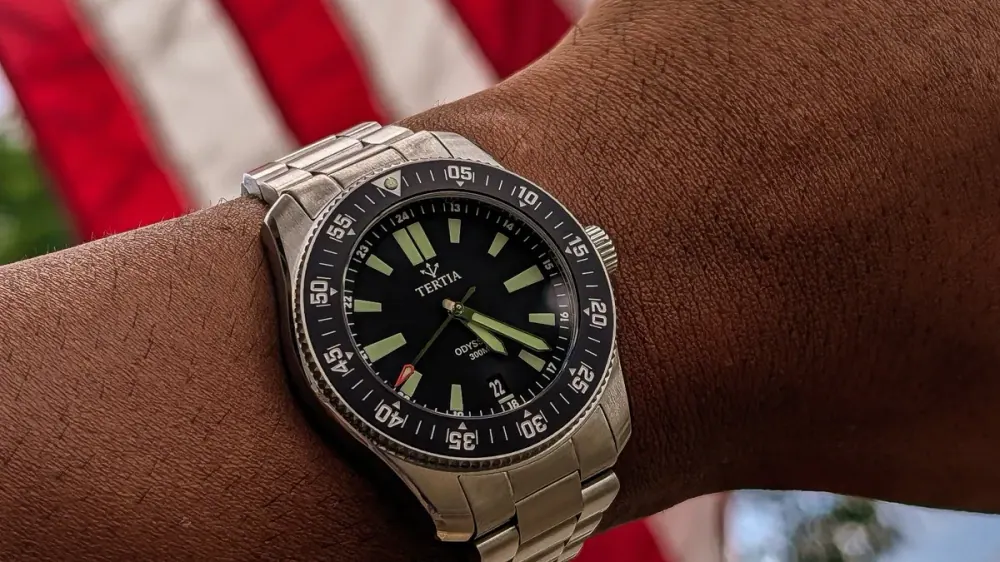
The Odyssey is a 40mm mechanical dive watch built from 316L stainless steel. It measures 47mm lug-to-lug and 12mm thick, gets a flat sapphire crystal, ceramic timing bezel, screw-down crown, and 300m of water resistance.
Inside is a Miyota 9015 automatic movement running at 28,800 vph with approximately 42 hours of reserve. Tertia regulates the movement in six positions before delivery (more on the Miyota later).
The watch came to me essentially naked—a prototype marked 000 of 000, with no papers or fancy packaging.

I knew that ahead of time and it didn't bother me one bit—I do appreciate how much that did seem to bother Ben though. As fun as ripping open a "govpack" item can be, it's not what he was cool with. He wants it to be ready to roll for anyone when they get their production version in-hand.
The production version comes with a bracelet, an FKM rubber strap, a nylon strap, and the tools needed to actually swap between them and adjust the length. Current founder pricing is $895, with regular pricing listed at $1,195.
None of those specifications are particularly shocking, but collectively they make a lot of sense.
“HONEY, THE SMALL ONES ARE MORE COMFORTABLE.”
Most of the watches I’ve gravitated toward lately have been in the 43–44mm range. I still wear 41s and 42s. I’ll wear smaller. But my eye has definitely become calibrated toward larger watches. As a result, my immediate reaction to the Odyssey was:
That looks small.
That reaction disappeared almost immediately. The thing is, I’m not actually a stranger to smaller watches, and there is something genuinely nice about putting on a watch that will disappear underneath a dress shirt instead of trying to eat the cuff.

I had a funny reminder of this during New York Watch Week. I handled a larger version of a watch that I had previously owned in 39mm. One of the few reservations I had about the original was its size, and eventually I sold it. Naturally, I assumed the larger version would fix that.
Then I tried it on.
The larger watch looked good. It had more wrist presence, and I liked how it felt... but almost immediately I realized that I preferred the 39. The smaller version was simply more visually striking.
That experience applies here. Would I like to see what a larger Odyssey looks like? Sure.
Do I think this watch needs to be larger? No.
LET'S TALK ABOUT THE UNDERSIZED BEZEL...
I’ve handled enough watches at this point to know when something looks a little funky proportionally before I even put it on. The Odyssey’s bezel caught my eye immediately because it is intentionally smaller than what the case could otherwise accommodate.
At first, I wasn’t sure what I thought about it. After living with the watch for a couple of months, it became one of the details I appreciate most.
Once the bezel is set, it stays there. No fancy locking mechanism needed. I’ve tried to get it to move unintentionally under a carrier, coming in and out of a chest rig, through normal movement, and during training. Unless I was doing something comically deliberate with my body, I couldn’t get the thing to click out of position.

That matters considerably more to me than whether the bezel fills every available millimeter of the case.
The action itself is also excellent. It is still crisp after months of use, alignment remains spot-on, and it has become one of my favorite bezel actions and sounds overall. There's also exactly zero back play, which is a lot to be said after being beat on for months by an infantryman and his cop friend.
At night, Tertia only illuminates the pip rather than the entire bezel. That actually works particularly well with the smaller diameter because I don’t need to fish around for the reference point. The pip is there.
That’s enough.
IT'LL DISAPPEAR, AND NOT JUST BECAUSE JOEY TOOK IT
The Odyssey is an extremely easy watch to wear. Put it on and don’t worry about it for a week or two. That is probably the easiest way I can describe it. It is well balanced enough that I don’t spend the day shifting it around my wrist or readjusting it.
During normal movement and training, I mostly forget that it is there. I wear my watches correctly (lol), so crown contact has never been a problem.
The bracelet might actually be one of my favorite bracelets at this price point, and I mean the $1,195 MSRP, not just the founder price. It makes sense. The construction is good. The clasp works. It has a great quick adjust that doesn't rely on anything flashy. I absolutely appreciate Tertia using screw pins instead of making me fight a pin-and-collar system.

The FKM strap is also legitimately good. I’m admittedly biased toward Divecore when it comes to rubber, but the supplied strap is comfortable basically immediately and doesn’t feel like something thrown into the box just to inflate the accessory list.
I’ve also worn the Odyssey on one of our J-11 straps. When I lift with it, I generally loosen the strap slightly, but that has considerably more to do with me preferring a tighter fit than anything the watch is doing wrong.
The larger point is that the production Odyssey arrives as a turnkey package. You get the bracelet, rubber, nylon, and tools. If you’re having this thing shipped to an APO or somewhere overseas where your immediate watchmaking infrastructure consists of “whatever showed up in the mail,” you really don’t need anything else.
Open the box, size it, put it on whatever strap makes sense, and go. For me, that has real value.
(GRUMBLING ABOUT A MIYOTA AT $1.2K)
Yes. There's a Miyota inside.
And?
I already know what some people are going to say. The Odyssey uses a Miyota 9015. Tertia regulates it in six positions, but it remains a Miyota 9015.
I like Miyota movements. I think they’re good. Rotor noise has never bothered me. I know there are people who can apparently hear a Miyota rotor from three rooms away and find this deeply offensive. I don’t.
The Odyssey has also been accurate enough that I can wear it for days or weeks without feeling compelled to reset it. I don’t have a measured number because I don’t currently own a timegrapher... Maybe I should get one?

The broader movement argument gets stupid pretty quickly anyway. People complain because a small brand uses Miyota. Then they complain that too many brands use ETA or Sellita. Then somebody develops or sources an in-house Swiss movement and suddenly everybody wants to know why the watch costs several thousand dollars.
Excuse me? You do realize there are consequences to all of those decisions, right?
Movements are not infinitely available. Large brands have buying power. Small brands are frequently fighting for whatever allocation they can actually obtain. And an exotic movement is not automatically a better movement for a tool watch.
The 9015 is accurate. It works. It is widely understood. And if I’m on the other side of the world and eventually need it serviced, I’m not particularly worried about finding somebody capable of working on it. I do not care whether it is Swiss.
There’s an old saying that you can be the ripest apple in the orchard and somebody still won’t like apples.
That applies here.
THE DIAL
The dial reminds me, in spirit, of the Peter Blake-era Seamaster. The inspiration is there, but it isn’t a carbon copy (that said, I'd not mind that... I miss mine!)
It has the same sort of immediate visual clarity. You look down and you know what time it is. Day or night. Done.
The dial is matte black, with a raised 24-hour chapter ring, broad hands, a red-tipped seconds hand, and Swiss X1 C3 Super-LumiNova. The handset does a particularly good job of giving you plenty of lume without completely saturating the dial. Everything remains proportionate. Everything remains easy to distinguish.

And the watch is simply handsome. I enjoy looking at it.
The 24-hour chaptering is funny because I personally barely pay attention to it.
My oldest did. He started looking at the watch and using the chapter ring to understand telling time from a 24-hour perspective. That probably taught me more about the usefulness of the feature than pretending I’m constantly using it for some mission-critical military application would.
It’s there. It works. Somebody found it useful.
Good enough for me.
SHE'S GOT SOME MILES
The Odyssey definitely shows signs of wear now. I loaned it to Joey, one of our podcast hosts, for a while, and he put it through the ringer. The most obvious result is a collection of some pretty gnarly scratches on the clasp.
Beyond that, nothing particularly interesting happened.
And that is a compliment.

The crystal remains clean. The bezel action is still excellent. The crown still feels fantastic. Alignment remains right where it should be.
The watch looks like it has been loved, not beaten. There is a difference.
WHAT DON’T I LIKE?
It should be known that I'm not a rubber stamp, yes-man. Plenty of watches have been returned and never published by me.
This is usually the part where somebody performing objectivity invents a problem.
I’m not going to do that.
Nothing about the Odyssey has genuinely bothered me in use. Though, there are things I would personally change.
I understand why Ben used a black dial. Black works. Black is easy. Black makes sense on a watch like this. Lately, though, I’ve gravitated more toward blues, grays, and extremely dark colors with some depth to them.
Breitling calls the dial on my Korea Special Edition Avenger “obsidian.” It is technically black, but depending on the light it can look like an extremely deep charcoal gray.

Something like that on the Odyssey could be excellent.
I’d also bring back drilled lugs. Ben had reasons for abandoning them. I still want them.
If you gave me total control and told me, “Burger King—have it your way,” give me an alternate version with a solid 316L bar running through the lug holes and make it a true fixed-bar watch.
And while we’re spending somebody else’s development budget, give me blue lume. Maybe blue on the dial with green on the handset and bezel pip.
There is nothing wrong with the green lume. I just think blue looks fantastic against black.
None of those things fix the Odyssey.
They are simply things I would like to see.
$1,195

This is where things get complicated.
Twelve hundred dollars is a tough pill to swallow for a lot of people, especially when the logo on the dial belongs to a brand they have probably never heard of. At this price, the Odyssey sits around watches like the Christopher Ward Trident, Squale 1521, some Yema offerings, and plenty of Seiko Prospex models. That is legitimate competition.
I’ve owned watches from those brands.
The Odyssey genuinely belongs in the conversation. Hell, if the dial said Seiko, you'd never be questioning it.
I actually think the Seiko comparison is one of the most useful. There are plenty of guys who like the basic Prospex proposition but don’t want another Seiko.
And somehow there are also people willing to go buy what is basically a copy of an existing, readily available Seiko because they want to do something “different.” All while they're being grossly overcharged for an AliExpresscial with a "custom" dial and clever marketing.

This is the better avenue of approach.
The Odyssey gives you much of the same basic functional proposition without simply handing you somebody else’s design with a different logo. I can look at this watch without immediately seeing another Seamaster or Submariner clone.
The price itself also needs a little context. I’ve collected long enough, reviewed enough watches, and handled enough product to realize something that I probably didn’t appreciate earlier: a lot of the watches we were happily buying for surprisingly little money were genuinely underpriced.
Inflation is real. Labor costs money. Manufacturing costs money. Movement supply costs money. That sucks for all of us.
It does not mean every price increase is justified. It does mean we should probably stop pretending that everything we remember buying for $600 is obligated to cost $600 forever.
At $1,195, Ben is not giving the Odyssey away, but I don’t think he is twisting the screws.
You get the watch, a legitimately good bracelet, FKM, nylon, the tools, sapphire, ceramic, 300m of water resistance, a proven movement, an original design, and, based on several months of wearing the thing, very good real-world performance.
It’s an honest price.
That doesn’t mean everybody is going to pay it.
WHO IS THIS ACTUALLY FOR?
I see three obvious buyers.
The first is the guy who absolutely has to have some military or law-enforcement connection attached to his gear. There is no getting around this. People are going to find Ben’s background and latch onto it.
That’s fine.
It just isn’t the primary reason I think the Odyssey works.

The second buyer is probably the most obvious. He wants something in the Seiko Prospex universe: hard wearing, mechanical, legible, actually water resistant, and reasonably affordable for what it is... but he does not want another Seiko.
The Odyssey makes a lot of sense there.
The third buyer is the guy moving up. Maybe he owns a Duro. Maybe a Seiko 5. Maybe he has spent a few years buying cheaper watches and is ready for his first legitimately substantial mechanical tool watch.
The only catch is that he needs to be willing to take a chance on a new company. That is still a real consideration.
Tertia has not had decades to prove itself. The Odyssey has to begin doing that work.
DID IT REPLACE ANYTHING?
No.
That isn’t really how I wear watches.
There are days where I wear two or three different watches simply because I want to and because I can. Hell, I go to work with a travel pouch containing two additional watches most days.

So asking what the Odyssey “replaced” in my collection doesn’t make much sense. The better question is whether it earned a place.
It did.
When Joey had it, I genuinely missed it. At one point I was starting to think I was going to have to fight him to get it back.
That probably says more than trying to manufacture some dramatic comparison against another watch in my collection.
THE IDEA ISN’T THE HARD PART
The Odyssey is not revolutionary.
Good. It doesn’t need to be.
It occupies a category already filled with excellent watches: hard-wearing, no-frills, mechanical, relatively affordable, reliable.
What makes the Odyssey interesting is that it manages to live in that category without immediately looking like somebody traced a Seamaster or Submariner and changed enough details to avoid getting yelled at.
It has its own identity. It has sensible specifications. It wears well. It has survived months of actual use without developing some annoying personality defect. And it is built around a movement that does exactly what I need it to do without making me care about what country is named on it.
There is nothing particularly special about seeing something missing from the market and deciding you want to make it yourself. People do that every day.
The impressive part is actually pulling it off.
Ben pulled it off.
The Odyssey is a hard-wearing, no-frills mechanical diver for someone who wants real capability without buying another watch that looks like a Seamaster or Submariner.
I think that is enough reason for it to exist.

@RoofKoreanActual is co-founder and a contributing writer at Sketchy Boyz Watch Club. He is first and foremost a husband and father of three sons. A conventional, active duty U.S. Army Infantry Officer, he brings a professional end-user's perspective to equipment reviews—writing for anyone who wants to know how gear actually performs under hard use.


